
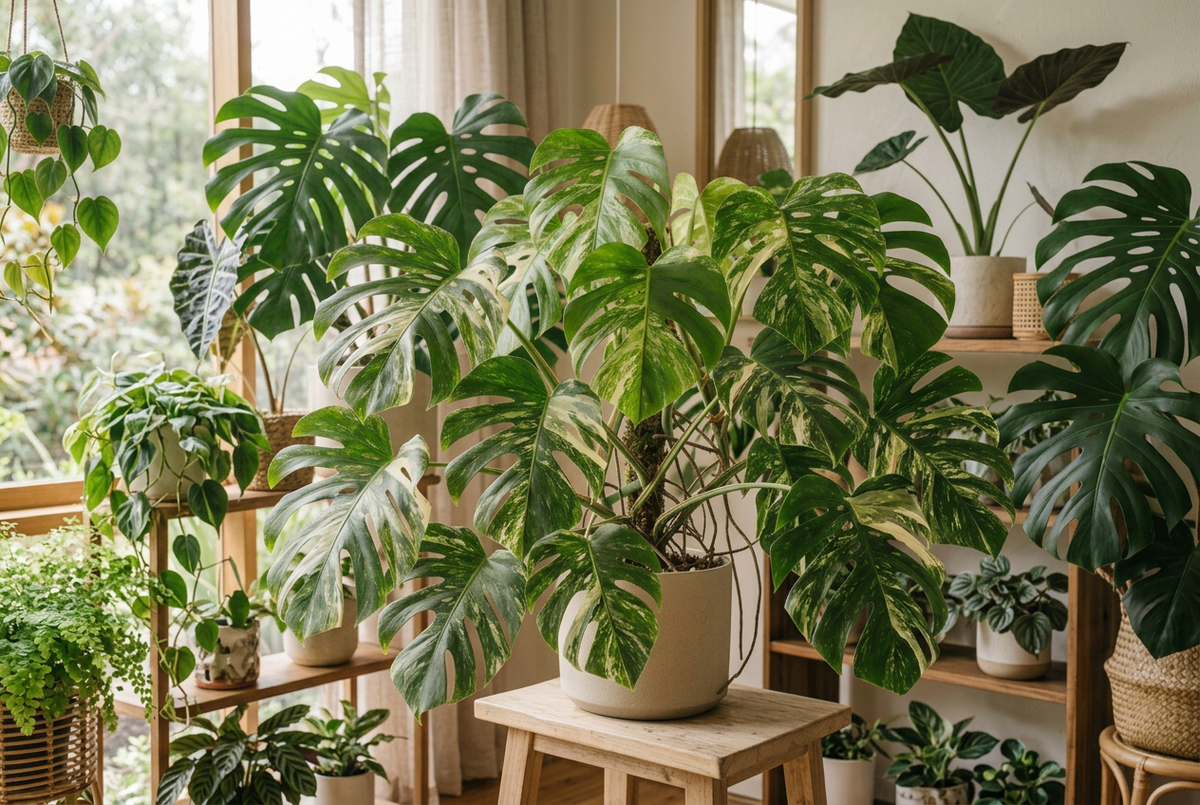
A healthy indoor plant collection starts with understanding what your plants need, not with collecting more bottles of fertiliser.
Monstera, Philodendron, Alocasia, peace lilies and other popular houseplants all depend on the same foundations: suitable light, a healthy root environment, appropriate watering and balanced nutrition. Get those working together and caring for your plants becomes much more straightforward.
This guide explains the essentials of indoor plant care, how to recognise common problems and how to build a practical care routine. An example using Growth Technology products shows where a complete nutrient and optional supplements can fit, without making them prerequisites for healthy plants.
1. Start with the right light
Light supplies the energy plants use to make sugars through photosynthesis. Without enough light, growth slows, water use decreases and even a well-fed plant can struggle.
“Low light” does not mean no light. A plant may survive in a dim corner without producing the strong growth or larger leaves you were hoping for. Adding extra fertiliser will not make up for a lack of light.
Descriptions such as low, moderate and bright indirect light are useful starting points, but they are not precise measurements. Conditions also change with the season, window direction, shading and distance from the glass.
Understanding PPFD and lux
Photosynthetic Photon Flux Density, or PPFD, measures the photosynthetically active light reaching a surface each second. It is expressed in micromoles per square metre per second, written as µmol/m²/s.
Lux measures brightness according to human vision. A lux meter can help compare different positions around your home, but a lux reading cannot be converted reliably into PPFD without knowing the light spectrum.
Practical light levels for indoor plants
The following indicative ranges offer a practical starting framework, not experimentally established targets for every plant listed. Plant examples describe broad light preferences and tolerance; they do not mean every species or cultivar thrives throughout the full numerical band. Light duration, growing conditions and acclimatisation also matter.
| Light level | Indicative PPFD (µmol/m²/s) | Approximate lux* | Plant examples and guidance |
|---|---|---|---|
| Low | 25–75 | 1,250–5,250 | Peace lilies, Aglaonema, pothos and heartleaf Philodendron tolerate lower-light positions. Growth may be slow, particularly at the lower end; peace lilies may flower less. |
| Moderate | 75–150 | 3,750–10,500 | Pothos, heartleaf Philodendron, Calathea / Goeppertia and many Peperomia are useful examples of plants suited to moderate indirect light. |
| Bright indirect | 150–250 | 7,500–17,500 | Monstera, many Alocasia and tropical Philodendrons suit well-lit, indirect-light positions. Check the species or cultivar and introduce brighter conditions gradually. |
| High | 250–400+ | 12,500–28,000+ | For plants with higher-light requirements, such as many succulents and flowering plants. Species-specific guidance is essential: some need considerably more light, while shade-adapted foliage plants may be stressed by abrupt exposure. |
*Lux figures are broad illustrative estimates using approximately 50–70 lux per µmol/m²/s, rather than precise conversions. The relationship depends on the spectrum of the daylight or white LED source and can fall outside this approximation. Do not apply these figures to coloured grow lights or treat them as independent species-specific lux targets.
The labels describe an indicative intensity guide, not whether sunlight is direct or filtered. A PPFD reading alone cannot tell you whether a plant will tolerate direct sun, leaf heating or a particular daily lighting period. Low-light tolerance is not the same as the light level that produces the best growth.
Plant-specific pointers
Peace lilies generally grow and flower better with moderate indirect light than in very dim positions. Aglaonema tolerates lower light but also benefits from useful diffuse light. Heartleaf Philodendron is more tolerant of low light than many other tropical Philodendrons.
Monstera deliciosa suits moderate to bright indirect light; variegated cultivars generally need more light than green forms. Calathea / Goeppertia suits moderate, filtered light rather than harsh direct sun. Snake plants tolerate poor light but generally grow better with moderate to bright light. ZZ plants can suit lower-light positions, but not a windowless room without grow lighting.
Rather than assigning every Monstera or Philodendron one fixed light target, consider the species, its previous growing conditions and its response to the position you choose.
Measure light at leaf height, not beside the light fitting. For a larger plant, check several positions across the canopy. Smartphone apps can provide an indication, but their accuracy varies with the device, calibration and light source.
Choosing a light meter
For direct PPFD readings, options include the Spot-On Quantum PAR Meter and the AZ Quantum PAR Light Meter. Both measure PPFD in µmol/m²/s, rather than lux, allowing you to compare readings with the indicative light ranges above.
The Spot-On is a compact handheld option. The AZ has a detachable sensor and an extendable stick, useful for taking readings across a larger canopy or in harder-to-reach positions. Follow the meter’s instructions for sensor placement and take readings at several leaf positions rather than relying on one measurement.
Intensity is only half the picture
Plants respond to both light intensity and the length of time they receive it. Daily Light Integral, or DLI, describes the total photosynthetically active light received over a day.
A brief bright reading beside a window does not necessarily mean the plant receives enough light across the whole day.
Grow lights can help where natural light is limited. Look for a manufacturer’s PPFD map at the distance you intend to use, rather than relying on a single maximum output figure. Set a consistent lighting period suited to your plants and retain a regular dark period.
Introduce brighter conditions gradually. Plants moved abruptly into stronger light may develop bleaching or scorched patches before they acclimatise.
2. Keep temperature and humidity reasonably stable
Many popular tropical foliage plants grow well in comfortable indoor conditions. Sudden changes can be more troublesome than small day-to-day variations.
Avoid positions beside heating outlets, cold draughts or air conditioners blowing directly onto the foliage. Windows can also create local extremes, particularly when strong sunshine heats the leaves.
Humidity matters most when you are choosing plants for a particular room. Ferns and some tropical foliage plants may struggle in dry air, while other houseplants cope more readily.
A humidifier can help where additional humidity is genuinely needed. Grouping plants may create a modest local effect, but it will not necessarily change the humidity throughout a room.
Keep air moving gently around the plants. Higher humidity should not mean stagnant air or foliage that remains wet for long periods.
Brown leaf edges are not proof of low humidity. Watering problems, damaged roots and fertiliser salts can produce similar symptoms, so check the whole growing environment before changing one thing.
3. Choosing the right growing media
The growing medium supports the plant while holding water, air and nutrients around the roots.
Unlike plants growing naturally in the ground, indoor plants are usually restricted to a relatively small pot. This makes the choice of growing medium particularly important.
A suitable growing medium should provide:
- Good drainage.
- Adequate moisture retention.
- Sufficient air around the roots.
- A structure that does not compact too quickly.

Potting mix
A good-quality potting mix is suitable for many common indoor plants. However, some tropical foliage plants benefit from a more open, free-draining mixture.
Check whether the mix already contains fertiliser, as this affects when additional feeding is needed.
Coco coir
Coco coir is made from processed coconut husks and is commonly used as a growing medium or as an ingredient in potting mixes. It holds moisture while maintaining a useful structure.
Growing in predominantly coco is not necessarily the same as using a potting mix that already contains fertiliser. Understand what your medium supplies before deciding on a feeding routine.
Perlite and pumice
Perlite and pumice are commonly added to growing mixes to improve aeration and drainage. They help create air spaces within the medium, which is particularly useful for plants that are sensitive to waterlogged roots.
Orchid bark and coco husk chips
Larger materials such as orchid bark and coco husk chips can be used to create a more open growing mixture. These are particularly useful for plants that benefit from additional root aeration.
Expanded clay / LECA as a mix ingredient
LECA stands for lightweight expanded clay aggregate. These porous clay pebbles can also be mixed through a potting mix to help open up its structure and improve aeration around the roots.
Used this way, LECA is a structural ingredient, alongside options such as perlite, pumice and bark. It is not limited to growing plants in a semi-hydroponic system.
Rinse off clay dust before use and choose a pebble size that suits the container and the other ingredients. The result depends on the whole mix, including particle sizes and proportions: adding a few pebbles will not automatically correct an overly dense or waterlogged medium.
A potting mix containing LECA is still managed as a potting mix. Check moisture before watering and allow excess water to drain; adding clay pebbles does not mean the pot should sit in a reservoir.
Creating a suitable mix
There is no single growing mix that suits every indoor plant. A moisture-loving Calathea may need a different balance of moisture retention and aeration from a climbing Monstera.
A useful approach is to start with a suitable potting mix and adjust its structure with materials such as perlite, pumice, bark, coco husk chips or expanded clay according to the plant’s requirements.
The right mix also depends on pot size, room conditions and how you water. A mix that works well in a warm, bright room may stay wet for too long in a cooler, darker position. Avoid assuming that adding more coarse material always produces a better mix.
Choose pots with drainage holes. Decorative cover pots are fine, provided drained water does not collect around the inner pot.
When repotting, match the new container to the root system rather than choosing a much larger pot automatically. Check the roots and the condition of the existing medium, not just the amount of foliage above it.
A separate growing method: semi-hydro with LECA
Growing a plant primarily in LECA with a managed nutrient reservoir is different from adding LECA to a potting mix. In a semi-hydro setup, the reservoir arrangement and water level should suit the container, plant and stage of establishment.

LECA supplies no nutrition of its own, so established plants need a suitable complete hydroponic nutrient. Follow the nutrient’s semi-hydro or hydroponic directions and monitor the solution as recommended. Plain water and clay pebbles are not a complete long-term feeding programme.
Prepare new LECA according to the supplier’s instructions. Monitor moisture and reservoir levels: the pebbles drain freely and hold less water than many other media, so roots can dry if water is no longer available.
Moving a plant from potting mix into LECA is a change of growing method, not simply a repot. Plants may need time to adapt, and root problems can occur during the transition. Start with a healthy plant and follow a suitable transition method rather than assuming every houseplant will adapt equally well.
4. Water according to the plant, not the calendar
One of the most useful indoor gardening habits is checking before watering.
The advice in this section applies primarily to plants in potting mixes and similar media, including mixes containing LECA. A deliberately managed semi-hydro reservoir is different from accidentally leaving a potting-mix plant standing in drained water.
Overwatering often means watering too frequently for the conditions, rather than simply applying a large amount once. If the root zone remains saturated, roots can struggle to obtain enough oxygen.
Check moisture below the surface and consider the weight of the pot. When the plant needs watering, wet the growing medium thoroughly and allow excess water to drain away. Empty any water collected in the saucer or cover pot.
Different plants need different moisture patterns. Some tolerate a greater dry-down between waterings, while others prefer more consistent moisture. Neither should be kept waterlogged.
Expect watering frequency to change with light, temperature, pot size and growth. A plant in a dim winter room may use far less water than the same plant beside a bright window in summer.

Water quality also deserves attention if problems persist. White deposits, recurring salt accumulation or unexplained root-zone issues may justify checking your water supply and feeding practices. Do not assume that every brown leaf tip is caused by tap water.
5. Feed for healthy growth, not faster growth at any cost
Plants require a balanced supply of essential nutrients.
Nitrogen supports leafy growth and chlorophyll production. Phosphorus contributes to energy transfer and other plant processes, while potassium plays important roles in enzyme activity and water regulation.
Calcium, magnesium and sulphur are also required, along with micronutrients such as iron, manganese, zinc, boron, copper and molybdenum.
A complete nutrient is usually a more sensible foundation than adding individual supplements without an identified need. More fertiliser does not automatically produce better growth. Excess feeding can increase salt accumulation and damage roots.
Before feeding, consider what is already in the pot. A recently repotted plant in a fertilised mix may not need the same approach as one growing in an inert medium.
Match feeding to the plant’s activity and follow the instructions for the nutrient and growing system you use. A stressed plant with damaged roots needs its underlying problem addressed, not a stronger feed.
Choosing a complete nutrient
Choose a product suited to your plants and growing method. Check whether its instructions cover potting mix, coco or hydroponic and semi-hydro systems, and use the appropriate directions. A supplement supplying one ingredient or function is not automatically a complete feed.
Optional supplements and foliar feeding
Plants can absorb certain nutrients through their leaves, but foliar feeding should supplement rather than replace an appropriate root-feeding programme. Follow the product instructions, avoid hot conditions and strong direct sun, and test unfamiliar sprays on a small area first.

Root-zone supplements and silicon products are optional additions. Silicon may support plant structure and stress tolerance, but responses differ between species and growing conditions. No supplement compensates for inadequate light, damaged roots or unsuitable watering.
Silica formulations can affect nutrient-solution pH and compatibility. Follow the particular product’s mixing instructions and avoid mixing concentrated products directly together.
For variegated plants such as Monstera Albo and Thai Constellation, keep expectations realistic. Do not rely on silica to control variegation or guarantee that pale leaf sections will never brown. Investigate light, watering, roots and nutrition if damage develops.
6. Propagation: start with healthy material
Propagation is a rewarding way to expand a collection, but success begins before you reach for a rooting product.
For plants such as Monstera, Philodendron and Pothos, select healthy stem material with a suitable node. A detached leaf without the necessary growing point will not reliably produce a new plant.

Use clean cutting equipment and a propagation method suited to the plant. Maintain appropriate moisture, warmth and light, while avoiding stagnant, excessively wet conditions.
If you use a rooting gel or propagation nutrient, choose one suitable for your cutting and method. Rooting products and nutrients have different functions; follow each label rather than assuming they are interchangeable.
As the young plant develops an established root system, transition to a feeding programme suited to its next stage of growth.
7. Read symptoms as clues, not diagnoses
A yellow leaf does not automatically mean a nitrogen deficiency. Brown tips do not automatically mean low humidity. Several different problems can produce similar symptoms.
When something changes, review recent watering, light, feeding and environmental conditions before adding a corrective product.
Yellowing leaves
Check whether the change affects an occasional older leaf or is spreading across the plant. Examine moisture levels, drainage and roots. Consider inadequate light, underwatering, overwatering and nutrition rather than assuming one cause.
Brown or crispy edges
Review watering consistency, heat, light exposure, humidity and possible salt accumulation. Existing dead tissue will not turn green again, so judge improvements by healthier new growth.
Slow growth
Consider the season and growing conditions. A plant receiving less light may grow slowly and need less water and fertiliser. Extra feeding is not a substitute for adequate light.
Small leaves and stretched stems
Insufficient light may contribute, although plant maturity and climbing support can also matter for some species. Improve conditions gradually rather than moving the plant straight into harsh sun.
Damaged new growth
Inspect carefully for pests as well as watering, root and environmental problems. Do not assume a nutrient deficiency before checking for insect activity.
8. Adjust care to Australian seasons
Use the seasons as a reminder to reassess conditions, not as a fixed feeding calendar. Australia’s climates vary, and indoor heating, air conditioning and grow lights can change the pattern considerably.
Spring is a useful time to inspect roots, refresh unsuitable media and review feeding as growth increases.
In summer, check moisture more often where heat and stronger light increase water use. Protect sensitive foliage from overheating near glass.
Through autumn, reassess watering as daylight changes rather than continuing the summer routine automatically.
During winter, plants in cooler, darker rooms may use less water and grow more slowly. Plants under consistent artificial lighting may remain active.
The plant’s actual growth and root-zone moisture are more useful guides than the month alone.
9. A simple feeding routine using Growth Technology
The following is one example of how to put the nutrition principles into practice, not the only way to grow healthy indoor plants. You do not need every product listed, and the products are not intended to be combined automatically at every watering.
| Role | Example product | Where it fits |
|---|---|---|
| Main nutrition | Foliage Focus | A complete nutrient formulated for foliage plants. Use the directions for your growing medium and system. |
| Optional foliar feeding | GT Foliar | A ready-to-use supplementary spray, not a substitute for root feeding. |
| Optional root-zone supplementation | GT Root Zone | An organic-based additive used alongside a complete nutrient. |
| Optional silicon supplementation | GT Silica | Follow its mixing instructions and check solution pH as directed. |
| Cutting preparation | Clonex Rooting Gel | Applied to the cut end before placing the cutting in its propagation medium. |
| Propagation nutrition | Clonex Clone Solution (CCS) | Nutrition during propagation and establishment, distinct from rooting gel. |

Begin with the complete nutrient
Foliage Focus can serve as the main nutrient for Monstera, Philodendron, Alocasia and other leafy houseplants. The manufacturer provides different dilution guidance for potting mix and hydroponic or semi-hydro systems. Use the directions appropriate to your setup and check the current label before mixing.
Keep watering and feeding decisions separate. A recommendation to feed when watering does not mean watering before the plant needs it. Consider fertiliser already present in the growing medium.
Add supplements only when they have a purpose
GT Foliar comes in a ready-to-use trigger pack. Apply a fine mist in low-light conditions, following the label. Avoid drenching the plant or spraying flowers and buds, and allow foliage to dry with suitable air circulation. Test a small area first on unfamiliar or sensitive plants.
GT Root Zone is an organic-based supplement formulated with marine and plant extracts, fulvic acid, and selected vitamins and minerals. It is designed for use alongside Growth Technology nutrients, not as a stand-alone complete feed. Address drainage, watering and root problems before considering an additive.
If using GT Silica, the manufacturer advises adding it to plain water first and mixing thoroughly before adding nutrients. Follow the current directions and check the completed solution as recommended for your system.
Keep propagation products for the propagation stage
Clonex Rooting Gel is applied to the cut end before the cutting is placed in the propagation medium. Choose the appropriate formulation and follow its label.
Clonex Clone Solution supplies nutrition during propagation and establishment. It is not the same product as rooting gel and should not be treated as interchangeable. Once roots are established, transition to a feeding programme suited to the plant’s next stage.
10. Keep the routine simple
Start with suitable light, an appropriate growing medium, correct watering and a complete nutrient where needed. Those principles apply whichever suitable nutrient brand or growing method you choose.
You do not need every supplement to grow healthy indoor plants. Introduce changes one at a time so you can observe the response rather than wondering which of several additions made a difference.
Final thoughts
Healthy indoor plants are usually the result of consistent care rather than complicated routines.
Understand the light available, keep the roots in a suitable environment, water according to need and provide balanced nutrition. When problems arise, investigate the growing conditions before reaching for another supplement.
Whether you are caring for your first Monstera or an established collection of tropical foliage plants, those foundations will help you make better decisions and enjoy stronger, healthier growth.
Explore our range of indoor plant nutrients, propagation products and growing essentials at Hydroponic Solutions.
Further reading
- Lighting for indoor plants, University of Minnesota Extension
- How to grow houseplants, Royal Horticultural Society
- Houseplant 101: Choosing the right light, Royal Horticultural Society
- Monstera deliciosa, NC State Extension
- Goeppertia, NC State Extension
- Soilless Growing Mediums, Oklahoma State University Extension
- A guide to compost mixes for houseplants, Royal Horticultural Society
- Foliage Focus product guidance
- GT Foliar application guidance
- Root Zone product guidance
- GT Silica mixing guidance
- Clonex Rooting Gel application guidance
- Clonex Clone Solution product guidance